Steamypuff Girls (Powerpuff Girls Go Steampunk)

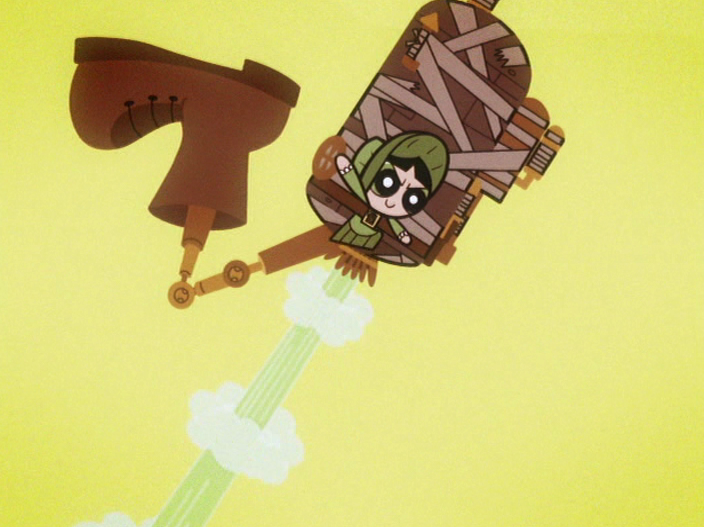
Just when I thought that Powerpuff Girls had done it’s finest pop culture reference ever (Meet The Beat Alls, complete with Beatles references and Yoko Ono), Craig McCracken created a vintage Powerpuff girls set in the wild west. I believe this may be the first steampunk cartoon made (back in 2004). It recreates the girls’ origins. This time they are created from sassafras, arsenic, and everything old fashioned. Chemical X is replaced with, what else, coal. They get their abilities from massive coal and steam powered rockets strapped to their backs.

The premise is simple. The girls fly after Mojo the Kid to bring him to justice. When their superpowers wane, the Professor simply shovels more coal into the girls’ contraptions. Finally, when the steampunk rockets are shattered (thanks to Mojo the Kid’s banana gun), the Professor invents “duly undercoated concentric tear-strip”, or duct tape, to repair the machines. Mojo punching ensues.
Watch this episode via this link (part 1, part 2). Enjoy.

Tim Kane
Spelling Shortfalls (Personal Word Demons)

I am not the world’s best speller. Yet I teach English as one of my core subjects in sixth grade. I’m a big believer in having a building error-checker. You should be able to sense when a word is wrong, even if you can’t figure out how to spell it correctly.

Ironically I was a finalist for a spelling bee in first grade. My stage fright was so great, that I pleaded with the teacher not to let me go. She obliged and I was spared the task of standing on stage and mangling words (though I must have been pretty good at that stage).

My error detector is fairly well tuned. I can sniff out some weird words even on printed paper (no squiggly red lines needed). Yet I do have my blind spots that, for whatever reason, baffle me.

Success: I am determined to spell this word as “sucess”. I think because the second C makes and S sound, my mind tunes it out.

Traveling: I desperately want to add another L to this, making it “travelling”.

Meet and Met: Whenever I type either of these words, I pause and sound it out to make sure I’m using the correct on. A year teaching Kindergarten helped with this.

Lose: This is my all time Achilles heel. I know it and still I type it wrong. I want to spell it as “loose”. In my defense, there is no logical phonetic reason for the spellings. Lose has that weird Z sound it it, like “looz”. Am I crazy here, or does it not sound like it should have a pair of Os in it? I mean, you try spelling it phonetically. It wouldn’t be such a big deal if “loose” weren’t around.

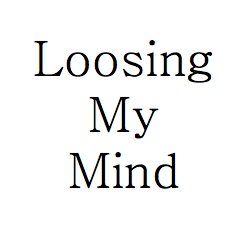
So next time you see a tweet or a blog post from me were I am “loosing my mind”, send me a quick message and tell me that my demon word has struck again.

Tim Kane

How Do You Define Yourself As A Writer?

Hi, I’m a creative and imaginative dreamer? Really? Sounds like you’re a bum to me.

Why can’t we get away with introducing ourselves via our talents? So often we define ourselves with jobs (teacher) and relationships (father of a wonderful daughter). Think about it, we even describe kids by their age or station. My daughter is 4 and a half, about to enter Kindergarten. Not a word about her personality at all.

As writers, we particularly suffer from this. I know that I do. I’ve published a non-fiction book and multiple short stories, yet why do I often feel like I’m not a “real” writer yet. Why? Because I don’t have that elusive “novel” published. It’s frustrating because I know I am a writer. I write. Every day. But it’s those accolades that we yearn for.

Perhaps we should all loosen up a bit. Let’s be what what we do. I write. Ergo, I’m a writer.

Nuff said.

Tim Kane

Protagonists-R-Us

We’re having a sale. Today only. Buy one protagonist, and get the antagonist at a fifty-percent discount. Such a deal. You can’t have one without the other.

I teach writing to sixth grade students. Here’s a typical plot line: Character meets another character and they talk. Then they meet a third character. They talk some more. Finally they all rush back to a) home, b) school, c) a castle. Yes, I know it matches up with a few of the Twilight books (don’t be a hater, I actually like Stephanie Meyers), but what most of my tween writers lack is an antagonist.

Or to be more specific, conflict generated by an antagonist. The two are inseparable. Yes I know that the protagonist herself can have doubts, thus generating conflict. Likewise, nature can also be an obstacle. But let’s face it, nothing beats a good ole white hat versus black hat. (If you wanted to go the Twilight route, Meyers handled that quite well.)

The antagonist defines the protagonist. He often strives for the exact same goal as the protagonist. Since only one can achieve that goal, it creates tension. I love antagonists that mirror the protagonist. For example, if I have a protagonist who hates monsters and the grotesque, I might pair him with a an antagonist who is a monster herself, yet despises it. Perhaps they’re both seeking the goal of destroying the evil beasts. Yet our hero does this out of fear and ignorance, while the villain strives for this goal from self loathing.

However you achieve it, make your antagonist linked to your protagonist. It creates a deeper bond and makes the final mano-a-mano showdown that much more interesting.

Tim Kane