Monthly Archives: April 2013
Let Me Download Your Book for Free (It’s My Religion)
What some people won’t do to get around supporting artists. I’m not one to prop up big corporations and their tireless lawsuits against kids copying music. Heck, I made my share of mix tapes and gave them away. But as a writer, I understand that if you give everything away, you can’t support yourself. Novels, songs, movies—these all take months and years to create. We all love the idea of the starving artist, but I also like to pay my rent.
Now there’s a movement in Sweden where copying and disseminating information is protected under the umbrella of religion. Yes, it’s true. The Swedish government has recognized Kopimism as an official religion. What are the doctrines? Glad you asked:
* All knowledge to all
* The search for knowledge is sacred
* The circulation of knowledge is sacred
* The act of copying is sacred
Sounds a bit scary doesn’t it. This is movement born from the hacker culture. By hooking onto a religion, the Kopimists can also gain political leverage. Does this mean that US hackers can claim amnesty for religious reasons? Probably not yet.
Looking through the official Kopimism site reveals some puzzling contradictions. On one hand, they state: “All people should have access to all information produced. A gigantic Boosting Knowledge for humanity.” This makes sense. Why hide valuable information? My first thought goes to helpful drugs that can benefit everyone.But then I spot this a few lines down: “The absolute secrecy is holy in the church of kopimism.” Doesn’t this contradict what they just said about shareing?
The Kopimist Church of Idaho (Yes, our Idaho) has a more straightforward approach. They want to send books to people in South America or Africa. Not bibles, but books. Any books. Pure information. This form of information sharing I can get behind. It’s like humanitarian aid for the mind.

Interestingly, this religion is officially tied to The Pirate Bay, a BitTorrent site that allows people access to movies, and music. In order to keep their servers away from copyright enforcers, The Pirate Bay has purchased remote drones to carry the servers 8,000-9,000 feet above Greek airspace. If the Greek government agrees, this could tie the Greeks into breaking copyright laws.
What’s the future for the Kopimist movement? Will governments grant them the ability to bypass copyright law? If so, I think you’d see a lot of cheap people flocking to this religion. It’s like the Napster of intellectual property.
Tim Kane
Genetically Engineered Animals for the Future
Scientists will always tinker. While they mostly seek to improve the world, some scientists stray into Frankenstein category. Now that the genome has been hacked open, also sorts of possibilities pop up, from the useful to the ridiculous.
Say you often can’t find your cat when she wanders around the house at night. Problem solved. Get a glow in the dark cat.
Yes, it’s true. South Korean scientists meshed a cat’s DNA with a red fluorescent protein. Why did they want glowing kitties? Just because.
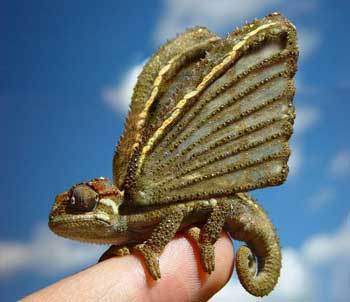
Although some of the genetic engineering works around possibility for science’s sake. Not everyone needs a glowing cat. But what about a dinosaur? Look at a modified Umbuku Lizard.
Those wings aren’t glued on. They were dormant in the lizard’s genes. A little tinkering brought them out. Scientists believe that this lizard is a descendent of the Pterodactyl, which lost its ability to fly some millions of years ago. To date only 6 of these flying Umbuku have been produced and they are kept seperate from the natural Umbuku due the risk of cross breeding.
Some genetic tinkering can produce results we can all use. Consider the fact that nearly all paper comes from wood pulp. However, you have to kill the tree to make the paper. What if you didn’t? Trees produce leaves every season. A Swiss-based company saw the possibilities. They engineered a tree whose leaves look like sheets of paper. That’s right. Just pluck a sheet and get writing. Bonus, the tree lives.
Up to this point, scientists have combined like items (plant with plant or animal with animal). Here comes the fern spider.
This is one of the first animal/plant hybrids. The Italian Wolf spider (Lycosa tarantula) was crossed with a ponga fern (Cyathea dealbata) to test the survival rates of creatures with camouflage.
Finally, this tinkering can be simply for the purpose of beauty.
The Japanese company, Suntory, managed to create a blue rose called “Applause.” Blue roses don’t exist in nature. Many horticulturalists strive for this coveted goal. The company mixed rose genes (Old Garden ‘Cardinal de Richelieu’) with a delphinidin-producing gene from a pansy.
Evolution Gone Awry (The Disturbing Art of Patricia Piccinini)
If you’ve never seen Patricia Piccinini’s sculptures, then you have missed out on a whole world of weirdness. Take a look at the photo below from “The Fitzroy Series” (2012). Look at the mix of an actual environment and the sculpted creatures. The boy sleeping in the bed? He’s probably a sculpture too.
She uses a combination of silicone, fibreglass and human hair to create her sculptures. Often she pairs her bizarre beings with imagined future beings.
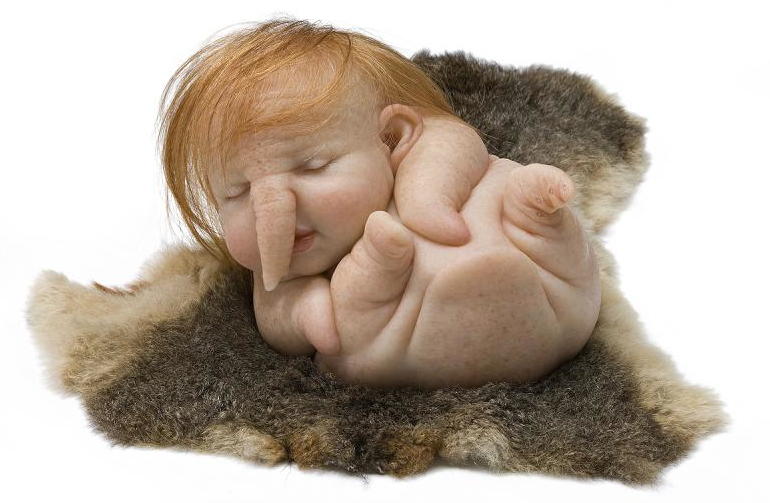
She also offers a series of sculptures that cause the viewer to question whether this is a creature that once lived or possibly a result of laboratory tinkering. Take a look at “Offering” (2009). Is this a dog? Perhaps a werewolf cub? It certainly evokes a warm babyish feeling.
Now take a look at “Newborn” (2010). Perhaps this is the offering grown a little larger?
This little guy looks comforting yet disturbing at the same time. Are those arms? Fingers? Tentacles? I’m not sure. Does it have a trunk?
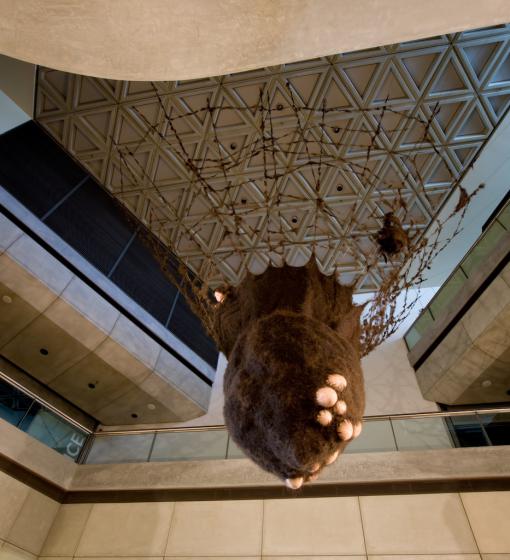
In her series “Aloft” (2010) she shows an ominous nest dangling above viewers’s heads.
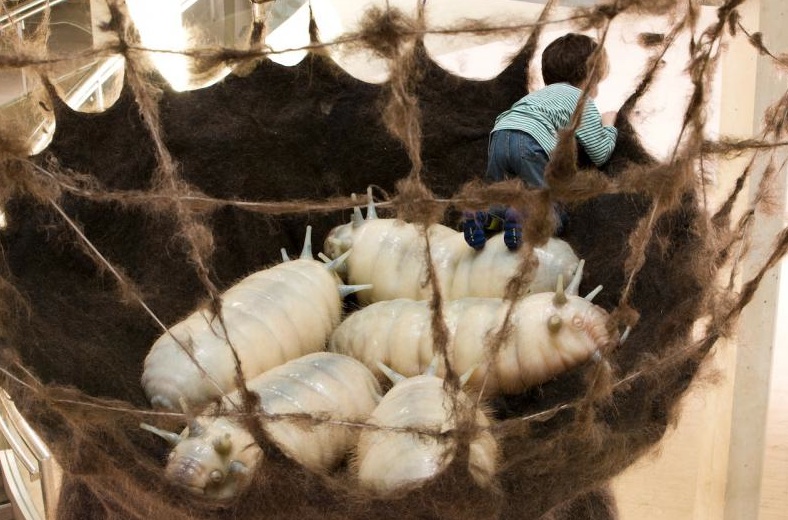
From the second story, viewers can see inside the nest. Note that the boy didn’t craw in there. He’s sculpted.
Yes, disturbing is this artist’s middle name. I don’t know what worries me more, the giant larval creatures or the kid about to tumble to the floor.
Finally, look at one of her most recent projects “Welcome Guest” (2011). Here we have more full grown creature paired with a child.
As always in Piccinini’s sculptures, the children look happy and calm when faced with the bizarre or unusual. This piece makes me wonder what the welcome guest evolved from. Those claws are disturbing.
To see more of Piccinini’s sculptures, visit her website.
Tim Kane
Creepy Critters and Insect Transformations
My life seems to be dominated by bugs. (Thankfully with no current infestations, though I could be jinxing myself.) It all started with a book: Wicked Bugs by Amy Stewart. I was pulled to it like flies to dung. I’d already read her previous book, Wicked Plants, and it was astounding.
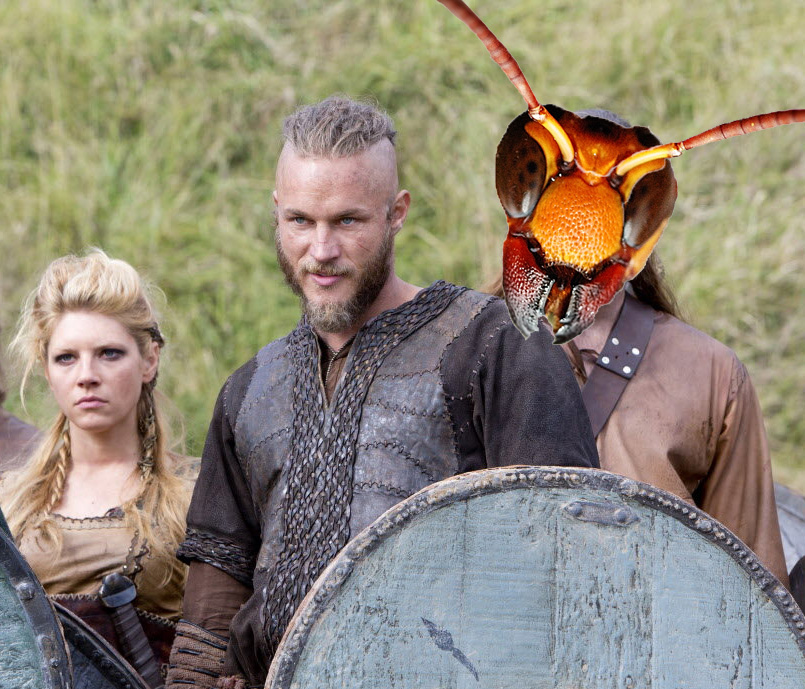
I’m only halfway through, but the descriptions of bed bugs kept me up at night (glancing around the room for possibly critters). One of the most intriguing insects so far is the Asian Giant Hornet. Not only is this creature gigantic (50 mm), it raids bee hives the way Vikings pillaged English towns.
One wasp will reconnoiter the hive, tearing off the heads of bees and bringing them back to its young. Then it smears pheromones and attracts a massive wasp raid. All the bees are destroyed, the larva and honey stolen away.
What really takes this to the next level is the defense that the bees mount. Too small to fight the wasp directly, they team up. The bees know that if they can dispose of the first wasp, the others won’t come. They lure the scout wasp inside the hive. The bees then proceed to flap their wings furiously, raising the temperature to a blistering 116 degrees. This cooks the wasp. The danger is that if the temperature kicks up a few more notches, it kills the bees.
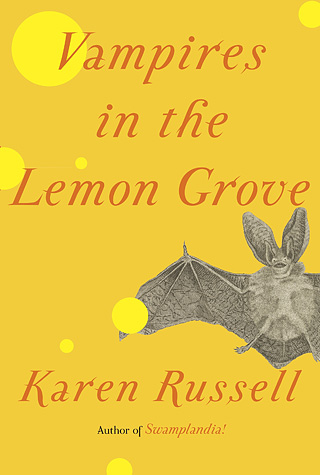
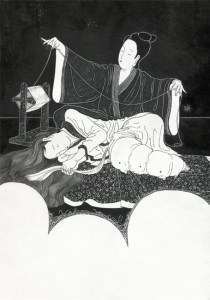
This isn’t the only literary insect encounter. I’m also currently reading Vampires in the Lemon Grove by Karen Russell. The second story, Reeling for the Empire, is both repulsive and alluring at the same time. It centers around Japanese women stuck in a modernizing nation (mid-nineteenth century). To compete with Western silk spinning machines, the Japanese alter their women to transform them into silk worm. They grow fuzzy body hair and rip off their fingernails to pull out the silk that builds in their bellies.
Cap all this off with the fact that my local museum, The San Diego Natural History Museum, has a bug exhibit (Dr. Entomo’s Palace of Exotic Wonders) featuring glowing scorpions, millipedes, bird eating tarantulas, and vinegaroons.
It’s enough to make you twitch and glance over your shoulder for bugs. At least I’m not degrading to the status of Upston Pratt from Creep Show. Not familiar? In the story, titled “They’re Creeping You Out”, a cranky tycoon has “bug-proofed” his penthouse (Howard Hughes has nothing on this guy). Suffice it to say, roaches find their way in, both to the apartment and his body.
Creepshow – They’re Creeping Up on You! from Veetrix on Vimeo.
Gross.
Enjoy the insect world. They outnumber us 200 million to 1.
Tim Kane